

Examining the Employment Rate for Disabled Individuals
Story by: Ella Adler Sacred Spaces Editor
As a child, you are often prompted to think of your dream job. Common responses include astronaut, movie star, and princess. Parents know that the odds of their children’s names bearing a star on the Hollywood Walk of Fame is low, but very few doubt that their child will find a secure occupation. For parents of special needs children, this is a worry that consumes their minds.
Jill Adler, the parent of a child on the autism spectrum says that she worries constantly about her son being an independent adult. While she knows of programs in the state that offer support to adults with disabilities, the future of her son is uncertain.
“He has services until he is 21 from his school district; we have to have a plan when he is 21, and who knows what that is going to mean,” Adler says. As her son approaches this looming age, they are looking at options for his future occupation.
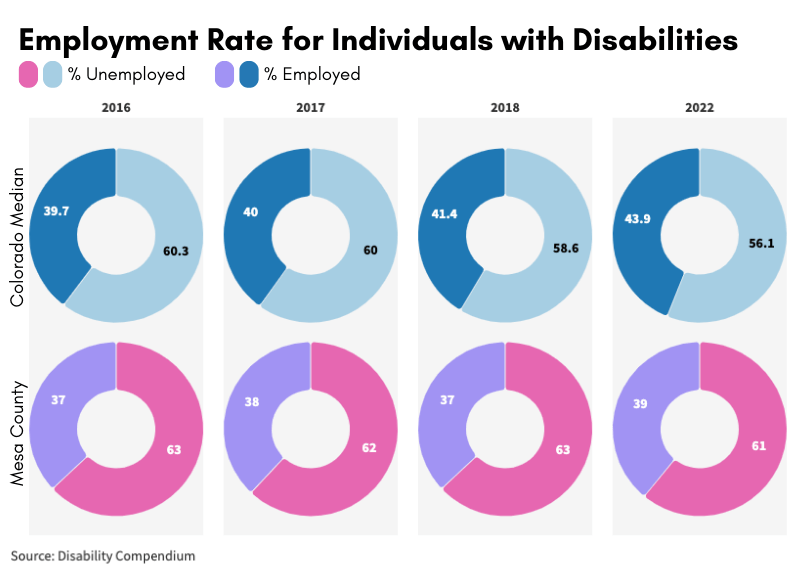
For Colorado residents, the odds of individuals like Adler’s son finding a job are higher than it has ever been. Over the last seven years, the median employment rate for people with disabilities across the state has increased by nearly 7%. According to the Disabilities Compendium, the current median employment rate for people with disabilities is 43.9%. This number is significantly lower than the median employment rate for people without disabilities, currently sitting at 78.2%.
Even with the statewide increase in employment rate, the rate in Mesa County has been stagnant for the last seven years. According to the same report from the Disabilities Compendium, 2% more people with disabilities are employed now than in 2017. Out of the 10,533 residents of Mesa County with a disability, 4,204 of them have a job.
“My concern as a parent is that he is so bright and has so many skills that I know could be useful to an employer,” Adler says. She goes on, to express her concern that even with her son’s high cognitive level, she is unsure that he would ever get past the interview process. “I also worry that particularly about employment that is sufficient enough for him to support himself.”
The percentage that is employed most commonly works at organizations such as the Arc that offer disability recruitment and staffing services. Adler says that while these organizations are beneficial for many disabled adults, her son does not necessarily fit the description for this type of “mercy” job, as she describes it.
These mercy jobs are found at organizations such as Arc Consignment Stores that pride themselves on hiring disabled individuals. In these positions, employees earn minimum wage, currently $13.25 in Colorado. According to the living wage calculator from MIT, the living wage in Grand Junction is $16.04 for a single adult household. If disabled individuals are only being hired at minimum wage jobs, they have no opportunity to support themselves.
One organization in Mesa County is looking to help increase the quality of jobs and the employment rate for disabled individuals. STRiVE, located off of N. 8th St. According to their website, the non-profit is “authorized by the State of Colorado to provide community-based services and support to individuals with disabilities and their families.”

Tanya Workman, the resource development manager at STRiVE, says that the provider side of the organization offers many programs for adults with disabilities. Among these programs are therapeutic day programs, vocational programs, and options for these adults to live with host families. The vocational program is the most requested service from the organization.
“Our main purpose here is to kind of integrate these individuals into the community,” Workman says. The organization oversees four local shops: Western Colorado Botanical Gardens, Alida’s Fruits, Pixel Gaming Lounge, and The Shop. Through these four companies, vocational positions are offered to individuals who request the service.
The worries expressed by Adler concerning her autistic son getting and maintaining a legitimate job are recognized and put to ease through the design of STRiVE’s vocational program.
The vocational positions are paid and designed to accommodate specific needs the employees may have. The opportunity to work in a legitimate environment offers a safe space for disabled individuals to learn social skills and build confidence in their abilities.
Workman leaves with this thought, “Our individuals are just like everybody else. They want the same things that everybody else wants. A social life, they want to get married. We are just here to make sure that they are able to live their lives to the full capacity.”
Organizations like STRiVE are aiming to equalize the unemployment rate between the disabled and non-disabled populations. While this type of company is on the rise in Mesa County, the needs of the disabled community need to be heard and supported. In order to support their ability to support themselves, the community must continue to support them.

 blockpartygj.net